Interests
Beauty of Football: The Invisible Flock
How football tactics emerge from simple local rules, positioning cues, and shared heuristics.
The Invisible Flock: How Football Tactics Actually Work in Real Time
It is incredibly easy to watch a post-match analysis show with its neon digital lines, shaded geometric zones, and sliding arrows, and think: “There is absolutely no way 22 people sprinting at 20 mph are calculating these isosceles triangles in real time.”
If football were purely a top-down, rigidly choreographed dance, it would be fragile. The moment a player tripped, a pass went stray, or an opponent did something unpredictable, the entire system would collapse.
The reality is far more fascinating. Players do not memorize a complex choreography; instead, they follow simple, local rules (heuristics) that organically create complex, global patterns.
1. The Bird Flock Analogy (Emergent Behavior)
Think about a massive flock of starlings twisting and turning in the sky. It looks like a beautifully rehearsed dance, but there is no choreographer bird shouting orders.
Every individual bird is just following three basic rules:
- Avoid colliding with my immediate neighbors.
- Fly in the same general direction as the birds next to me.
- Stay close to the group.
When hundreds of birds follow these simple rules simultaneously, stunning geometric shapes emerge naturally. Football operates exactly the same way. Managers don’t tell a midfielder, “At minute 14, form a diamond.” They give them mental shortcuts based on four reference points: The Ball, the Space, the Teammate, and the Opponent.
2. Core Concepts: The 3 Local Rules to Watch
To train your eyes to see past the ball, select a single player or unit and track them for 5-10 minutes. Below are the three most distinct tactical patterns explained through their localized player rules.
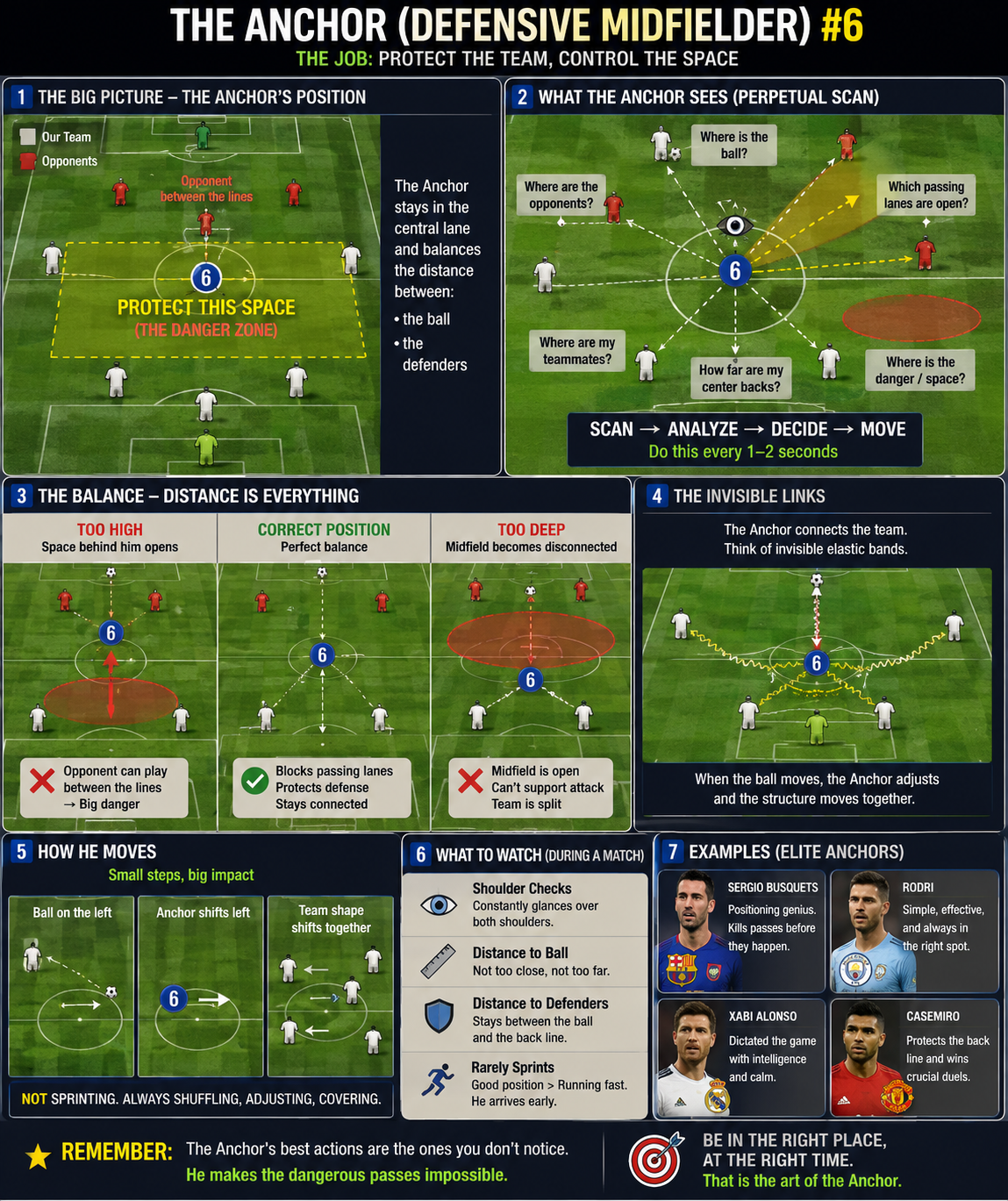
Rule 1: The Defensive Midfielder (The Anchor)
- The Heuristic: “Distance to Ball == Distance to Defenders”
- The Movement: The Defensive Midfielder (DM) acts as the anchor of the team. They rarely engage in full, lung-busting sprints across the pitch; instead, they operate with maximum energy efficiency, constantly micro-adjusting their positioning in the central lane.
- The Scan: They perform a perpetual 360-degree scan over both shoulders to evaluate the space before the ball even arrives.
Rule 2: The Opposite Winger (Stretching the Flock)
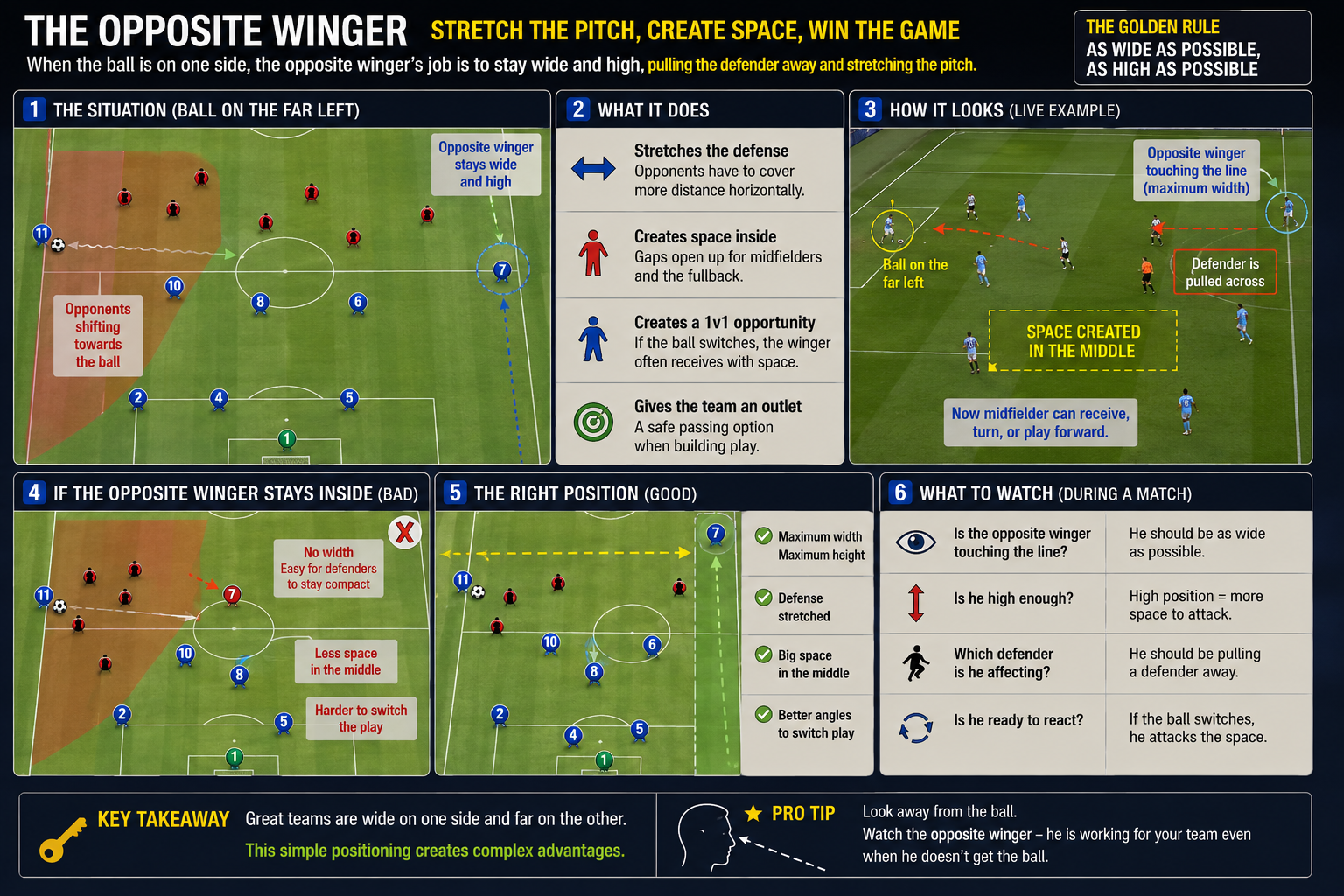
- The Heuristic: “Maximize distance from the chaos to isolate the opponent.”
- The Movement: When the ball is heavily contested on the far-left side of the pitch (the High-Pressure Cluster), the right winger does not move toward the ball. Instead, they stick their boots to the opposite white touchline.
- The Consequence: This extreme width forces the opponent’s defensive block to stretch, dragging at least one isolated defender away from the center and opening up passing lanes.
Rule 3: The Center-Back Line (The Covering Cord)
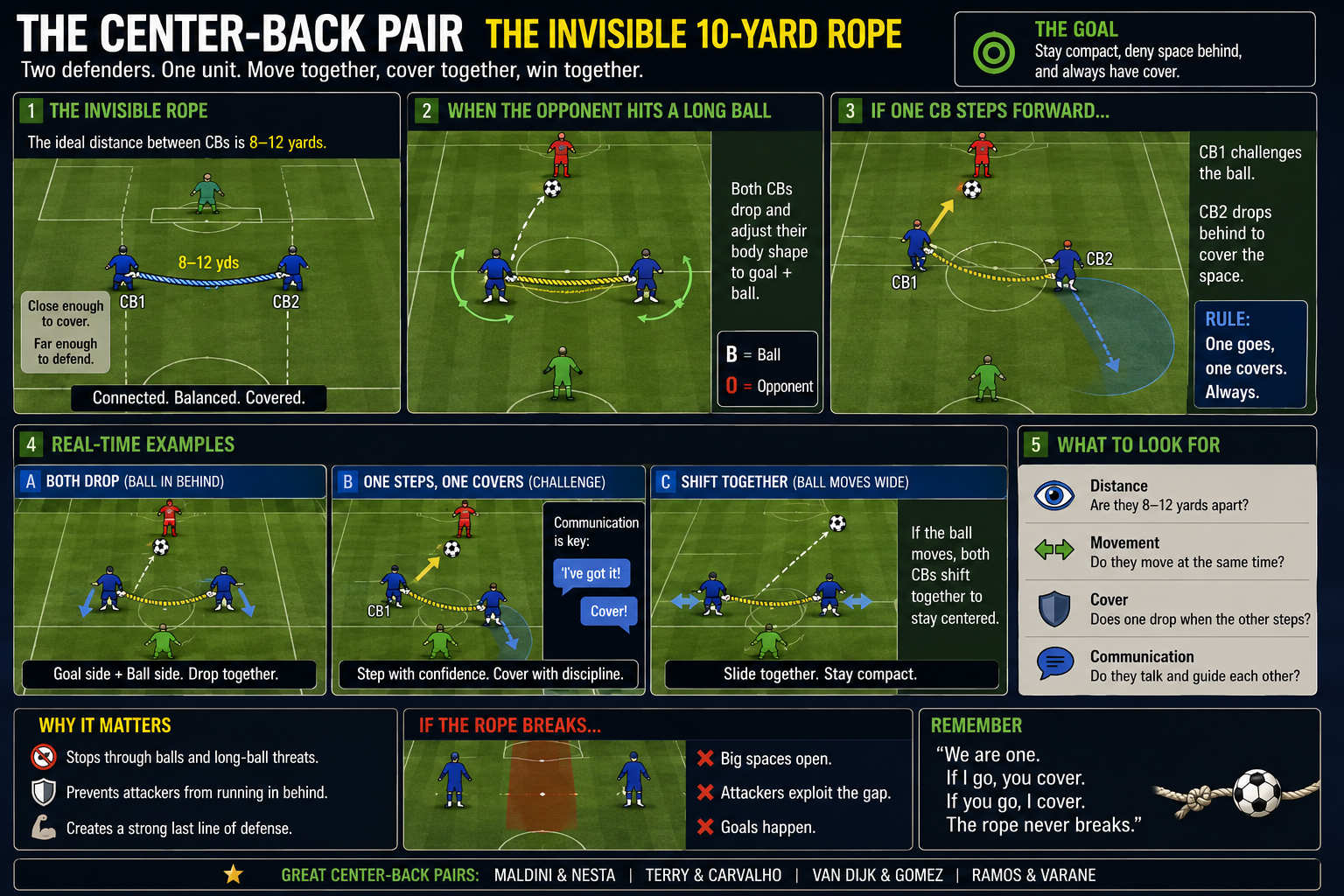
- The Heuristic: “Maintain the 10-yard rope; if my partner steps up, I drop back.”
- The Movement: The two central defenders move back and forth in perfect synchronicity as if tied by an invisible cord. When a long ball is played, they never challenge for it together.
- The Consequence: One Center-Back steps forward to challenge the attacker, while the second Center-Back instantly drops back to secure the “Coverage Zone,” sweeping up any loose balls or flick-ons.
3. Recommended YouTube Resources for the World Cup
To deepen your understanding before the tournament, watch these specific breakdowns that bridge abstract theory with real player mindsets:
- What is Positional Play? (Tifo Football by The Athletic) A brilliant visual guide using minimalist animations to explain how pitches are split into grids and how top managers use space occupancy to break down stubborn defenses.
- Play, Possession, Position - Pep Guardiola’s Tactics (Sky Sports Retro) Thierry Henry stands in front of a tactical board to explain his first-hand experience playing under Pep. He breaks down how rigid structural discipline in the first two-thirds of the pitch creates complete creative freedom in the final third.
- Every Position In Football Explained in 8 Minutes (Football Explained) A rapid, high-yield overview explaining the core jobs of every single position on the pitch from the goalkeeper to the striking department.
4. Tactical Spectrum: Fragile vs. Antifragile Systems
| Tactical Style | System Type | How it Works | Real-World Example |
|---|---|---|---|
| Rigid Choreography | Fragile | The manager scripts exact movements. If the opponent presses unexpectedly or a player gets injured, the team panics and breaks. | Rigid, old-school direct play with no adaptability. |
| Dynamic Heuristics | Antifragile | The manager provides basic rules, but players possess choice. Opponent chaos and high pressure actually trigger creative solutions. | Modern “Positional Play” or “Relationism” (e.g., Real Madrid, Manchester City). |
By mastering these simple heuristics, you transition from someone who just “follows the ball” to an observer who understands the invisible geometric tension animating the entire field.